
Part of our IT and finance careers hub: every B&M guide on this topic, in one place.
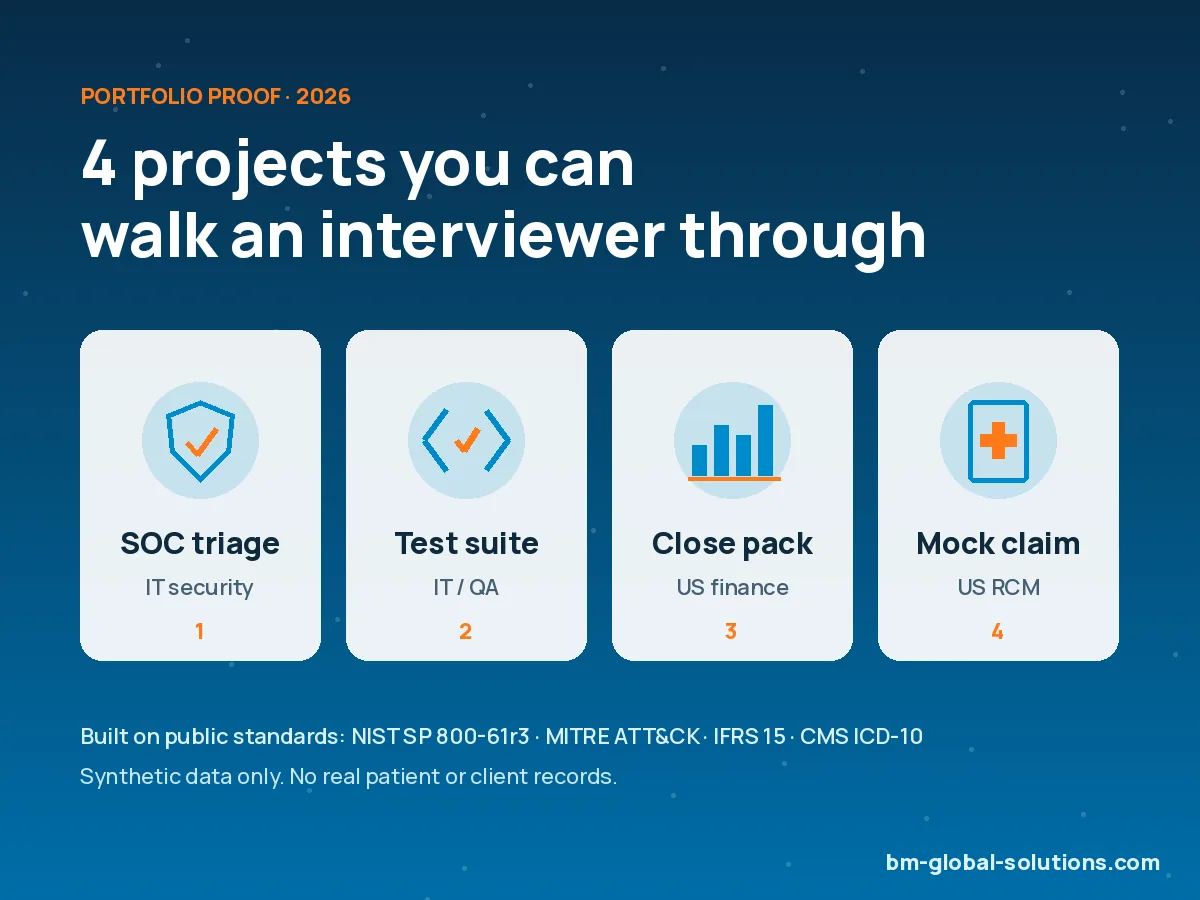
A certificate tells an interviewer what you studied. A small, honest project shows what you can do on a Monday morning. For entry and early-career roles on Indian IT, US finance and US healthcare revenue cycle (RCM) desks, the most useful portfolio is not a big app. It is four or five pages of work you can open on screen and explain step by step in ten minutes.
This is general information, not career, immigration or legal advice, and nobody can promise you a job, a salary or a visa. Every hiring decision rests with the employer. B&M Global Solutions runs readiness cohorts, places candidates directly with employers inside India only, and routes overseas enquiries strictly through licensed recruitment agents.
Below are four projects, one per track, each anchored to a public standard that interviewers and teams in these fields actually work from. Each one uses synthetic or public sample data only. Never put a real employer's, client's or patient's data in a portfolio.
Project 1 (IT security): a SOC alert triage write-up
What you build. Take one public sample log set or a lab you ran yourself, pick three alerts (for example a burst of failed logins, a suspicious PowerShell command and a phishing email), and write one page per alert: what fired, what you checked, whether it is a true or false positive, and what you would escalate.
The standard to anchor it to. Map each finding to a technique in MITRE ATT&CK, which MITRE describes as a globally accessible knowledge base of adversary tactics and techniques based on real-world observations. Then label your steps with the incident response life cycle in NIST SP 800-61 Revision 3, published in April 2025. Rev. 3 supersedes the 2012 Rev. 2 and places incident response inside the NIST Cybersecurity Framework (CSF) 2.0, so using its language shows you have read the current version, not an old summary.
What to show in the interview. The query you ran, the two or three fields that decided the verdict, and a five-line escalation note a shift lead could act on. Our SOC Analyst L1 interview roadmap lists the skills this project should touch.
Project 2 (IT quality): a small automated test suite
What you build. Choose a public demo web app made for practice, write 8 to 12 end-to-end tests (log-in, search, add to cart, a negative case for a bad input), run them in a free CI pipeline and keep the report.
The standard to anchor it to. Playwright Test is described in its official documentation as an end-to-end test framework for modern web apps, bundling a test runner, assertions, isolation and parallel runs, and supporting Chromium, WebKit and Firefox on Windows, Linux and macOS, locally or in CI. Selenium or Cypress work too; what matters is that you can explain why each test exists and what a failure would tell the team.
What to show in the interview. One failing test you fixed, the trace or screenshot that showed the cause, and how you kept the test from being flaky. See our QA automation and SDET roadmap for the wider skill list.
Project 3 (US finance): a month-end close pack with one revenue case
What you build. In a spreadsheet, create a fictional small company with one month of transactions: a bank reconciliation with two timing differences, three accrual entries, and a trial balance that ties out. Add one revenue contract, for example software plus a year of support, and work it through the revenue model.
The standard to anchor it to. IFRS 15 sets out five steps: identify the contract with a customer; identify the performance obligations; determine the transaction price; allocate it to each performance obligation on the basis of relative stand-alone selling prices; and recognise revenue when (or as) each obligation is satisfied, which is when the customer obtains control. If the desk reports under US GAAP, the matching topic is ASC 606, Revenue from Contracts with Customers; read its wording in the FASB Codification before the interview. Show which obligation is recognised at a point in time and which over time.
What to show in the interview. The reconciliation, the journal entries with a one-line reason each, and the revenue schedule. Our US GAAP, IFRS and cloud accounting skills guide covers the tools these desks use.
Project 4 (US healthcare RCM): a mock claim, edit check and denial note
What you build. Write three short fictional patient encounters. Code each with ICD-10-CM diagnoses and the matching procedure codes, check the code pairs against the edit logic, then write one denial follow-up note as if the payer had rejected a line.
The standard to anchor it to.
- ICD-10-CM code set. CMS states that the FY 2027 ICD-10-CM files apply to discharges and patient encounters from 1 October 2026 to 30 September 2027. Use the current year's code set and say so in your project.
- NCCI edits. CMS explains that the National Correct Coding Initiative procedure-to-procedure edits exist to prevent improper payment when incorrect code combinations are reported, and that the medically unlikely edits exist to prevent improper payments when services are reported with incorrect units of service.
- Denial reason codes. X12 publishes the Claim Adjustment Reason Codes, for example code 16 (claim or service lacks information or has submission or billing errors), code 50 (non-covered because not deemed a medical necessity by the payer) and code 97 (benefit included in the payment for another service already adjudicated).
- Privacy. Under the HIPAA Privacy Rule's Safe Harbor method, de-identification means removing 18 kinds of identifiers, from names and dates to record numbers. The simplest rule for a portfolio is to invent every patient from scratch.
What to show in the interview. Your code choices with the guideline you relied on, one edit you caught, and a calm, specific denial note. Our US medical coding and RCM skills guide explains the role tracks.
How to present the four projects
| Project | Track | Public anchor | Time to build | What the interviewer can see in 10 minutes |
|---|---|---|---|---|
| SOC triage write-up | IT security | MITRE ATT&CK, NIST SP 800-61 Rev. 3 | About a week | Query, verdict, escalation note |
| Automated test suite | IT quality | Playwright Test documentation | About a week | Green CI run, one fixed failure |
| Month-end close pack | US finance | IFRS 15 five-step model | 4 to 5 days | Reconciliation, entries, revenue schedule |
| Mock claim and denial note | US RCM | ICD-10-CM FY 2027, NCCI, X12 CARC | 4 to 5 days | Codes, edit caught, denial note |
The build times are our planning estimates for a learner putting in a few hours a day, not a rule. Keep each project to one folder or one shared document with a short README: the goal, the data source (synthetic or public), the steps, and what you would do next. Link only to your own work.
Next step
Get the free IT and finance roadmap
See each track's skills week by week, the published course fee and the kind of roles hiring now.
Sources checked
NIST Computer Security Resource Center, SP 800-61 Rev. 3 publication page (published April 2025). MITRE ATT&CK home page. Playwright documentation, Installation and introduction. IFRS Foundation, IFRS 15 Revenue from Contracts with Customers. CMS, ICD-10 codes page (2027 ICD-10-CM files) and National Correct Coding Initiative edits page. X12, Claim Adjustment Reason Codes list. HHS, guidance on de-identification of protected health information under the HIPAA Privacy Rule. All checked on 19 November 2026.
Frequently asked questions
Do I need real company data for a portfolio project?
No, and you should not use it. Build every project on synthetic or public sample data. For healthcare work, invent every patient: the HIPAA Safe Harbor method lists 18 kinds of identifiers that must be removed for data to count as de-identified, and a made-up record avoids the question entirely.
Which standard should a SOC portfolio project follow in 2026?
Map each finding to a MITRE ATT&CK technique and describe your steps using NIST SP 800-61 Revision 3, published in April 2025, which replaced the 2012 Revision 2 and ties incident response to the NIST Cybersecurity Framework 2.0.
Which ICD-10-CM code set should an RCM practice project use now?
For encounters from 1 October 2026 to 30 September 2027, CMS says to use the FY 2027 ICD-10-CM files. State the code set year in your project so the reviewer knows what you coded against.
Will a portfolio guarantee me a job?
No. A portfolio helps you show skills clearly in an interview, but every hiring decision belongs to the employer. B&M does not promise jobs, salaries or visas.
How long should each project take?
Our planning estimate is four days to a week each for a learner working a few hours a day. Small and finished beats large and half-built. Which of the four would you build first: SOC triage, a test suite, a close pack or a mock claim? Tell us on WhatsApp and we will point you to the right week of the IT and finance roadmap.
Back to the IT and finance careers hub
General information only, not legal or immigration advice. Confirm every step with the official source.